문제 : https://www.acmicpc.net/problem/1269
1269번: 대칭 차집합
첫째 줄에 집합 A의 원소의 개수와 집합 B의 원소의 개수가 빈 칸을 사이에 두고 주어진다. 둘째 줄에는 집합 A의 모든 원소가, 셋째 줄에는 집합 B의 모든 원소가 빈 칸을 사이에 두고 각각 주어
www.acmicpc.net
문제 요약 : 주어진 집합 A와 B의 대칭 차집합 원소 개수 출력
| 입력 | 출력 |
| 1 ≤ A, B(원소 개수) ≤ 200000 1 ≤ A[N], B[N] ≤ 100000000 |
A, B의 대칭차집합 원소 개수 출력 |
JAVA
소스코드 : https://github.com/cbkpar/BOJ/blob/main/boj_1269.java
| 채점 번호 | 아이디 | 문제 번호 | 결과 | 메모리 | 시간 | 언어 | 코드 길이 |
| 30840117 | cbkpar | 1269 | 맞았습니다!! | 66516KB | 612ms | Java 11 | 821B |
import java.io.BufferedReader;
import java.io.IOException;
import java.io.InputStreamReader;
import java.util.HashMap;
import java.util.StringTokenizer;

public class Main {

	public static void main(String args[]) throws IOException {
		BufferedReader br = new BufferedReader(new InputStreamReader(System.in));
		int a,b,i,s;
		HashMap<Integer,Boolean> map = new HashMap<>();
		StringTokenizer st = new StringTokenizer(br.readLine());
		s = a = Integer.parseInt(st.nextToken());
		b = Integer.parseInt(st.nextToken());
		st = new StringTokenizer(br.readLine());
		for(i=0;i<a;i++) map.put(Integer.parseInt(st.nextToken()),true);
		st = new StringTokenizer(br.readLine());
		for(i=0;i<b;i++) {
			if(map.containsKey(Integer.parseInt(st.nextToken()))) {
				s--;
			}else {
				s++;
			}
		}
		System.out.println(s);
	}
}
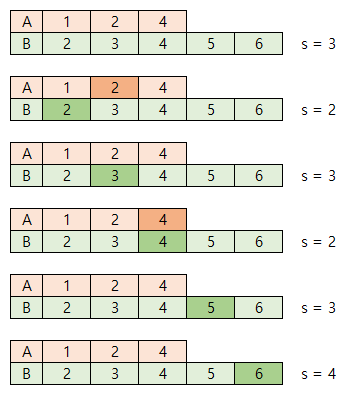
S의 값을 집합 A의 개수로 초기값을 둔 뒤
HashMap을 이용하여 A의 원소를 모두 넣고
B의 원소를 차례대로 확인하며
HashMap에 해당 키가 있을 경우 S를 1 감소시키고
HashMap에 해당 키가 없을 경우 S를 1 증가시킨다.
예제 )
A = {1, 2, 4}
B = {2, 3, 4, 5, 6}
'백준온라인' 카테고리의 다른 글
| [백준온라인] 22114번 창영이와 점프 (0) | 2021.07.11 |
|---|---|
| [백준온라인] 22113번 창영이와 버스 (0) | 2021.07.10 |
| [백준온라인] 11536번 줄 세우기 (0) | 2021.07.08 |
| [백준온라인] 10163번 색종이 (0) | 2021.07.07 |
| [백준온라인] 6965번 Censor (0) | 2021.07.06 |